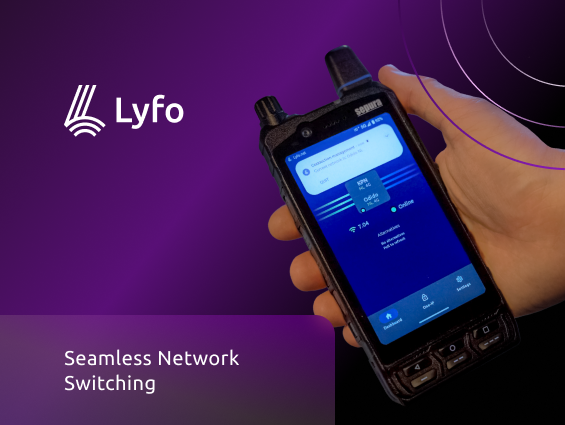


Lyfo.net automatically switches your device between mobile networks to keep you connected. Seamless Network Switching is an add-on to Lyfo.net, that takes it a step further, making sure your team doesn’t notice network switching at all!
Without a connectivity tool like Lyfo.net, a phone stays on its primary network, whether private or public, until that network becomes unusable. For instance, due to coverage gaps, a network outage, or in the case of a private network, when leaving or entering the private network’s operational area. At that point, the device searches for an alternative on its own. That process can take several minutes, and there’s no guarantee it finds the best option.
In the meantime, calls drop, messages don’t go through, and alarm notifications don’t arrive. For teams working in areas with uneven coverage, such a gap can seriously impact a team’s ability to do its job.
Lyfo.net solves that. When it detects that your current network is degraded, it automatically moves your device to a suitable available alternative without manual intervention or lingering delay.
The remaining challenge is that switching networks, even as quickly as Lyfo.net does, creates a momentary interruption in your connection. Typically, real-time applications such as Push-to-Talk (PTT), VoIP calling, or alarm notification systems detect this and must reestablish their connection over the new network. Depending on the application, the reconnection takes anywhere from a few seconds to a minute or more. For most users, that delay is tolerable. For teams that can’t afford even small breaks in communication, reducing that gap is critical.
Seamless (Mobile) Network Switching works by maintaining a connection below the application layer, so when your network changes, your apps see continuous data flow rather than a drop and reconnect. The result is a reconnection delay of a fraction of a second.
In practical terms, a Push-to-Talk user might notice a half-word gap in audio. Most of the time, they notice nothing at all.
It’s an add-on to Lyfo.net, currently available for Android devices. It runs entirely in the background, meaning end users don’t need to interact with it. Lyfo’s team, in collaboration with the organization’s IT administrator, handles the initial configuration through Lyfo’s backend portal, and once it’s set up, there’s nothing left to manage.
Because Seamless (Mobile) Network Switching operates below the application layer, your existing encryption and security protocols are completely unaffected – the only thing that changes is which network path your data travels over.
The result is simple: “Your team stays connected, and nobody has to think about how!”
Seamless (Mobile) Network Switching is most relevant for organizations where continuous connectivity is operationally critical.
Public safety teams like police, fire, and ambulance services depend on Push-to-Talk and real-time data applications where a multi-second interruption can affect coordination in the field. For these teams, the difference between a 200-millisecond hiccup and a 7-second reconnect can be critical to the health and safety of their team and community.
Healthcare organizations using mobile alarm notification systems are another clear fit. When alarm calls travel over a data connection, a network interruption means a missed alert – which typically triggers an escalation and pulls in additional staff.
Transport and logistics teams operating across large coverage areas also benefit. A phone moving from one national network to another can take several minutes to migrate on its own, meaning dropped calls and missed messages at the worst possible time. Seamless Switching, paired with Lyfo.net’s automatic network migration, can keep apps running throughout.
Industry who are typical users of Private Network have a need to be on their private network, but when travelling in or out of restricted coverage areas, or with coverage gaps, want to ensure that (certain of) their business-critical mobile services remain operational.
Mobile connectivity is only as useful as it is reliable. Lyfo.net automatically puts your devices on the best available alternative network, and Seamless Switching ensures that, when that happens, your team doesn’t notice.
Interested in adding Seamless Network Switching to your Lyfo.net deployment?